High-Performance Wall Washer Lights for Building Facade IlluminationBuilding facades increasingly serve more than a structural function. Hotels, commercial towers, cultural venues, retail centers, transportation hubs, and public buildings use exterior lighting to define architectural form, improve nighttime visibility, and create recognizable visual identities. As projects become larger and energy regulations more demanding, facade lighting has moved from simple floodlighting toward precisely engineered optical systems.
Among these systems, wall washer lights are designed to distribute light across vertical surfaces with controlled intensity and beam geometry. Their performance depends not simply on LED wattage, but on optics, thermal management, enclosure design, materials, driver quality, installation geometry, and long-term environmental resistance.
What Makes a Wall Washer Suitable for Facade Illumination?
A wall washer is a linear or compact exterior luminaire designed to illuminate a broad vertical surface. Unlike a conventional floodlight that may produce a relatively uncontrolled beam, a properly specified wall washer uses secondary optics to shape the distribution and direct light toward the facade.
The most important parameters are:
Beam angle and beam shape
Mounting distance from the facade
Luminaire output and efficacy
Color temperature and CRI
Optical uniformity
IP and mechanical protection
Thermal performance
Driver reliability
Control compatibility
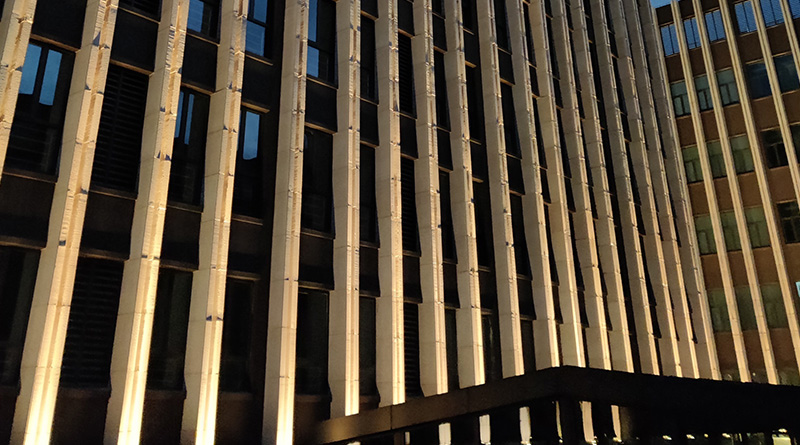
Beam selection should be based on the relationship between fixture position and facade dimensions rather than on beam angle alone. Narrow optics can be useful for tall columns, architectural details, and distant mounting positions, while wider or asymmetric distributions are generally better suited to broad surfaces.
For example, commercially available architectural systems may offer narrow, medium, wide, and elliptical optics for different facade geometries.
Core Technology: Optics, LEDs and Light Distribution
The optical system is one of the most important components in wall washer lights. Secondary lenses made from optical-grade PMMA or polycarbonate can control the horizontal and vertical distribution of light. TIR and freeform optics are also used where more precise beam shaping is required.
For facade projects, asymmetric optics can be particularly useful because they direct more light toward the wall instead of wasting output above or behind the fixture. This can improve visual uniformity while reducing unwanted spill light.
LED selection also affects the finished appearance. High-quality LED packages provide more stable color characteristics and predictable lumen maintenance. For architectural projects, CRI should be selected according to the materials being illuminated. Neutral or warm white light can reveal masonry, stone, metal, glass, and painted surfaces differently.
Color temperature is another design variable. Warm white around 2700–3000K is commonly associated with hospitality and heritage environments, while 4000K can provide a cleaner appearance for offices and contemporary commercial buildings. RGB and RGBW systems are appropriate when dynamic facade scenes or event-based color changes are required.
Product Structure, Materials and Manufacturing
A professional exterior wall washer normally combines several functional layers:
Housing: Extruded or die-cast aluminum provides structural strength and creates a heat-transfer path from the LED module to the surrounding air.
LED board: Many linear products use an aluminum or metal-core PCB to improve thermal conduction from the LED package.
Optical components: Individual lenses, reflectors, or molded optical elements determine the final beam pattern.
Front cover: Tempered glass or high-quality optical polymer protects the optical system from environmental exposure.
Sealing system: Silicone or equivalent gaskets, sealed end caps, and properly designed cable entries prevent moisture and dust from reaching electrical components.
Mounting hardware: Adjustable brackets allow installers to fine-tune the projection angle after installation.
Extruded aluminum housings with machined or die-cast end sections are common because they combine mechanical rigidity with thermal performance. Some professional products use stainless-steel mounting components and reinforced gaskets for demanding outdoor environments.
Manufacturing quality is particularly important at interfaces between different materials. Uneven gasket compression, poorly machined end caps, inadequate cable glands, or inconsistent adhesive application can compromise enclosure performance even when the basic housing design appears robust.
Thermal Management Determines Long-Term Performance
High initial lumen output does not necessarily indicate a high-performance luminaire. LED junction temperature has a direct influence on lumen maintenance, color stability, and component life.
Effective thermal design normally creates a continuous conductive path:
LED → PCB → thermal interface → aluminum housing → external environment
The housing therefore functions as part of the cooling system. Long extruded bodies can provide substantial heat-dissipation area, while external fins may further increase surface area.
Driver placement should also be considered. In hot climates, separating the driver from the LED housing can reduce thermal stress and make maintenance easier. Outdoor architectural systems may be specified for environments ranging from below-freezing conditions to approximately 50°C, depending on the design.
A useful specification should therefore include operating temperature, driver efficiency, thermal test conditions, and lumen-maintenance data rather than relying only on nominal wattage.
Environmental Protection: IP Rating Is Only One Part of Reliability
Facade luminaires are exposed to rain, dust, condensation, temperature cycling, ultraviolet radiation, and airborne pollutants. An appropriate ingress-protection rating is therefore essential.
IP66, for example, indicates protection against dust and powerful water jets under the applicable test conditions. IP67 involves a different water-ingress test and should not automatically be interpreted as a superior choice for every facade installation. The actual project environment should determine the required enclosure design.
Material selection is equally important in coastal or industrial environments. Aluminum housings require suitable anodizing, powder coating, or other corrosion-resistant treatments. Stainless-steel hardware may be preferable where salt exposure is significant.
Importantly, an IP rating represents a defined test condition rather than a guarantee of unlimited field durability. Cable-gland design, gasket aging, thermal expansion, installation orientation, and maintenance practices can all influence actual service performance.
Key Factors When Evaluating Wall Washer Lights
For B2B purchasing teams, several technical indicators deserve attention before comparing unit prices.
1. Photometric data
Request IES or LDT files and review beam distribution, spacing, vertical illuminance, and uniformity. A higher lumen rating is not necessarily better if much of the light misses the target surface.
2. Thermal performance
Look for documented operating temperatures, LED junction-temperature control, heat-sink construction, and lumen-maintenance information.
3. Driver quality
The driver should match the input voltage, dimming method, control protocol, load range, and environmental conditions. Flicker performance can also matter in commercial and media-sensitive applications.
4. Mechanical and corrosion resistance
Check housing alloy, coating process, glass thickness, gasket construction, bracket material, and fastener grade.
5. Compliance documentation
Depending on the market, projects may require standards and certifications covering luminaire safety, electromagnetic compatibility, ingress protection, hazardous substances, or regional electrical requirements. IEC 60598-1 covers general requirements and tests including classification, marking, mechanical and electrical construction, and photobiological safety.
Selecting a Reliable Lighting Supplier
Supplier evaluation should extend beyond a product catalog. A technically capable supplier should be able to provide complete specifications, photometric files, component information, test reports, production controls, and traceability.
For large facade projects, procurement teams should consider:
Consistency between production batches
LED binning and color consistency
Driver availability and replacement strategy
Optical sample approval
IP and environmental testing
Factory quality-control procedures
Spare-part availability
Warranty terms and exclusions
OEM or customized optical requirements
Technical support during installation
Sample testing is especially valuable. A fixture that performs well in a laboratory or product brochure may produce a different visual effect when installed at the actual mounting distance and facade geometry.
Common Problems in Facade Lighting Projects
Several recurring problems are caused by specification decisions rather than LED technology itself.
Hot spots: Excessive brightness near the fixture can result from unsuitable optics or insufficient mounting distance.
Uneven illumination: Incorrect fixture spacing, beam overlap, or facade geometry can create bright and dark zones.
Color inconsistency: Different LED bins or poorly controlled RGB/RGBW channels can produce visible variations between adjacent fixtures.
Water ingress: Weak cable entries, deteriorated seals, or poor end-cap assembly can eventually allow moisture into the housing.
Premature lumen depreciation: Inadequate heat dissipation can accelerate LED aging.
Excessive glare: Incorrect aiming or overly broad optical distributions can create discomfort for pedestrians and neighboring properties.
These issues demonstrate why facade lighting should be designed as a complete system rather than selected according to fixture wattage alone.
Typical Applications
Hotels and resorts often use warm-white wall washing to emphasize entrances, columns, terraces, and architectural textures.
Office and commercial buildings may require consistent white illumination across large elevations, with dimming schedules that reduce energy consumption during low-occupancy periods.
Museums and cultural buildings require more controlled color rendering and glare management because facade materials and architectural details are often central to the visual concept.
Historic structures typically benefit from lower-impact optical systems that highlight masonry and decorative elements without excessive brightness.
Retail and entertainment venues can combine white illumination with RGBW control for seasonal events, branding, or programmed facade scenes.
In each case, the mounting distance, facade material, viewing distance, surrounding environment, and local lighting requirements should be considered before finalizing the luminaire specification.
Current Trends and Future Development
The development of wall washer lights is moving toward greater optical precision, improved energy performance, and more integrated control.
One important direction is the use of asymmetric and freeform optics to achieve more light on the target surface with less spill. Another is the expansion of networked control, including DMX-based dynamic lighting and digital building-control interfaces.
Energy efficiency is also becoming increasingly important. Public procurement criteria in Europe, for example, can include requirements related to lumen maintenance, service life, spare parts, and product verification.
Future systems are likely to place greater emphasis on lifecycle performance rather than headline lumen output. Better thermal modeling, replaceable components, improved corrosion protection, recyclable materials, and more precise digital photometry can all reduce maintenance requirements over the operational life of a facade.
FAQ
What beam angle is best for building facades?
There is no universal beam angle. Narrow beams suit columns and tall architectural elements, while wider or asymmetric optics are generally more appropriate for broad walls. Mounting distance and facade height should be evaluated together.
Is IP66 sufficient for outdoor facade lighting?
IP66 can be appropriate for many exposed facade installations, but the correct rating depends on the project's environmental conditions and applicable specifications. Coastal, flood-prone, or unusually exposed locations may require additional enclosure and corrosion protection.
What material is best for a wall washer housing?
Aluminum is widely used because it combines low weight, corrosion resistance when properly treated, and good thermal conductivity. The alloy, surface treatment, machining quality, and surrounding hardware all affect long-term performance.
How should wall washer performance be compared between suppliers?
Compare photometric files, beam distribution, efficacy, CRI, CCT consistency, thermal data, IP testing, driver specifications, materials, certifications, warranty conditions, and sample performance—not just wattage or lumen output.
Conclusion
High-performance facade illumination requires a balance between optical control, thermal engineering, mechanical construction, electrical reliability, and environmental protection. The best wall washer lights are not simply the brightest fixtures; they are systems designed to place the right amount of light on the right architectural surface while maintaining predictable performance throughout their service life.
For architects, lighting designers, contractors, and procurement teams, evaluating photometry, materials, thermal design, enclosure construction, compliance documentation, and supplier capability together provides a more reliable basis for specification and long-term project performance.

 Español
 Portugues
 Pусский
 Français
 Deutsch
 日本語
 한국어
 العربية
 Italiano
 Nederlands
 Ελληνικά
 Svenska
 Polski
 ไทย
 Türk dili
 हिन्दी
 Indonesia
 Melayu
 Tiếng Việt
 中文
 dansk
 Magyar
 қазақ
 বাংলা
 עִברִית
 čeština
 Soomaali
 မြန်မာ
 فارسی
 українська
 norsk
 Gaeilge
 беларускі
 Română
 ພາສາລາວ
 Filipino
 lietuvių
 Cymraeg
 македонски
 Suomalainen
 slovenský
 o'zbek
 اردو
 հայերեն
 Igbo
 български
 سنڌي
 Shona
 සිංහල
 Hrvatski
 íslenskur
 galego
 català
 Zulu South Africa
 Afrikaans isiXhosa
 ಕನ್ನಡ
 lëtzebuergesch
 Indonésia Sunda
 Кыргызча
 тоҷикӣ
 Србија
 Twi
 Hawaii
 Cebu
 नेपाल
 euskara
 frissi
 יידיש
 latvija
 slovenija
 kiswahili
 ਪੰਜਾਬ
 پښتو
 საქართველოს
 hua moni
 bosna
 Kreyòl ayisyen
 Eesti
 Gàidhlig na h-Alba
 Samoa
 Монгол
 Azərbaycan
 አማራ
 Shqipëria
 Malagasy
 Malta
 ខ្មែរ
 Chicheva
 中文(繁体)
 ଓଡିଆ
 Setswana
 Afrikaans
 Aymara
 Башҡорт
 Türkmenler
 ትግሪኛ
 Afaan Oromoo
 অসমীয়া
 Kinyarwanda
 Ilocano
 Wolof
 अवधी
 Oluganda
 Bikol
 Fulɓe
 Kikongo
 Sango
 ދިވެހި
 Lingala
 मैथिली
 Tsonga
 ꯃꯦꯏ ꯊꯥꯏ꯫
 brezhoneg
 Furlan
 नेवा
 རྫོང་ཁ
 Santali
 Аҧсуа
 Нохчийн
 Чӑваш
 Татар
 Batak Karo
 دری
 Diura
 Fengyu
 Eʋegbe
 Iban
 Fiji
 Tonga
 Inuktitut
 Nahuatl
 maaya yucatec
 Runasimi
 guarani
 Qafar
 Acholi
 Dinka
 Luo
 Lundi
 isiNdebele
 Tshivenḓa
 Sesotho sa Leboa
 Sesotho sa Borwa
 Ndumbe
 Papuan Pidgin
 Rromani ćhib
 Thok Nath



 Phone
Comment
(0)