LED In-Ground Lights for Elegant Outdoor Landscape IlluminationOutdoor lighting has shifted from simply providing visibility to becoming an integrated part of architectural and landscape design. In hotels, commercial developments, public spaces, residential estates, parks, and urban streetscapes, lighting designers increasingly need fixtures that remain visually discreet during the day while producing controlled, durable illumination after dark.
Among the available technologies, LED in-ground lights occupy a distinctive position. Installed flush with paving, soil, decking, or architectural surfaces, they can illuminate trees, façades, pathways, columns, signage, and landscape features without introducing prominent fixtures into the visual environment. Their value, however, depends less on LED wattage alone than on optical design, thermal management, sealing, structural strength, drainage, materials, and installation quality.
Why In-Ground Lighting Is Becoming More Important
Landscape and architectural projects are becoming more demanding in both visual quality and lifecycle performance. Designers want lighting that defines circulation routes, reveals textures, emphasizes vegetation, and creates depth without excessive glare.
Energy efficiency is also an important procurement consideration. The U.S. Department of Energy notes that luminaire efficacy, measured in lumens per watt, is a useful indicator when evaluating exterior lighting efficiency.
This has encouraged project teams to move away from indiscriminate high-output illumination toward more accurately controlled light distribution. A lower-power fixture with an appropriate beam angle can sometimes produce a better architectural result than a more powerful fixture with poor optical control.
For this reason, modern LED in-ground lights are increasingly evaluated as complete optical and mechanical systems rather than simply as LED products.
What Are LED In-Ground Lights?
LED in-ground lights are recessed luminaires designed to be installed at or below ground level. Depending on their configuration, they may function as uplights, wall washers, pathway markers, accent lights, or linear illumination systems.
A typical round or square unit consists of:
LED light source and PCB
Optical lens or reflector
Heat-dissipation structure
Electrical driver or remote driver connection
Die-cast aluminum, stainless steel, or other structural housing
Tempered safety glass
Sealing gaskets
Mounting sleeve or installation box
Cable and waterproof electrical connections
Stainless steel or reinforced trim
The optical assembly determines how the light leaves the fixture. Narrow beams can emphasize tree trunks, columns, sculptures, or architectural details, while wider distributions are more appropriate for walls and larger landscape surfaces. Commercial products commonly provide multiple beam options, including narrow, medium, wide, and asymmetric distributions.
IP Rating Is Only Part of Outdoor Reliability
Water resistance is one of the first specifications buyers examine, but IP protection should not be treated as the only indicator of durability.
IP67, for example, indicates protection against dust and temporary immersion under the conditions defined by the relevant testing system. It does not automatically mean that a fixture can withstand vehicle loads, poor drainage, aggressive chemicals, or long-term thermal cycling.
For pedestrian areas, IP67 is commonly specified for recessed outdoor luminaires, while high-impact applications may additionally require an IK10 or higher impact classification. Some commercial products combine IP67 with IK10 and reinforced stainless-steel or aluminum construction.
The installation environment must therefore determine the specification.
A pedestrian walkway, landscaped garden, hotel entrance, parking area, and driveway should not necessarily use the same mechanical construction.
Materials and Construction
Material selection has a direct influence on corrosion resistance, thermal performance, structural stability, and service life.
Die-cast aluminum is widely used because it provides relatively efficient heat transfer while keeping the fixture lightweight. Proper surface treatment, such as anodizing or powder coating, can improve environmental resistance.
Stainless steel is often selected where mechanical strength and corrosion resistance are particularly important. Marine-grade stainless steel such as 316L can be appropriate for demanding environments. Some high-end linear in-ground luminaires use 316L stainless steel housings and encapsulation systems for additional environmental protection.
Tempered glass is another important component. The lens must withstand thermal cycling, accidental impact, cleaning procedures, and—in drive-over applications—mechanical loading. Some commercial in-ground luminaires use thick tempered glass together with stainless-steel structural components and defined load ratings.
The housing, lens, gasket, cable entry, driver compartment, and mounting system should be evaluated as one assembly rather than independently.
Thermal Management and LED Performance
Heat is a critical engineering consideration because recessed fixtures have less access to natural airflow than many surface-mounted luminaires.
Excessive junction temperature can accelerate LED lumen depreciation, affect color consistency, and reduce the expected operating life of electronic components. A well-designed fixture therefore uses a thermally conductive housing or dedicated heat sink to move heat away from the LED and driver.
Manufacturers should provide meaningful thermal test data rather than relying solely on generic lifetime statements. Buyers should examine:
LED junction or case-temperature assumptions
Ambient-temperature rating
Lumen maintenance information
Driver operating temperature
Continuous operating conditions
Thermal protection mechanisms
Testing methodologies such as IES LM-79 and LM-80 are among the recognized approaches referenced by the U.S. Department of Energy for evaluating LED lighting performance and lumen maintenance.
Drainage and Installation: The Frequently Overlooked Factor
Many failures attributed to a “poor-quality” fixture actually originate from installation conditions.
An in-ground luminaire sits in an environment where rainwater, irrigation water, soil moisture, cleaning chemicals, and condensation may be present. Even a highly sealed enclosure can experience significant environmental stress if water remains trapped around the fixture.
A proper installation should consider:
Drainage beneath the mounting sleeve.
Stable foundation support.
Correct finished-ground height.
Cable protection and suitable connectors.
Avoidance of standing water around the lens.
Adequate load-bearing support for walk-over or drive-over applications.
Compatibility between the fixture and surrounding paving materials.
This is particularly important for recessed products installed in concrete or vehicle-accessible areas. Manufacturers of commercial luminaires commonly specify both appropriate drainage and structural foundation support as part of the installation requirements.
Optical Design Determines the Quality of Illumination
A technically durable fixture can still produce poor results if its optics are incorrectly selected.
For example, a narrow 10° beam can create a concentrated vertical effect suitable for wall grazing or highlighting architectural elements. Wider 30° or asymmetric distributions can provide more uniform coverage across larger surfaces. Commercial in-ground systems demonstrate this principle through interchangeable optics designed for wall grazing, accent lighting, and broader illumination.
Color temperature should also correspond to the environment. Warm white around 2700–3000K can complement hospitality landscapes, historic architecture, wood, and vegetation. Neutral white around 3500–4000K may be more suitable for contemporary commercial architecture or areas requiring greater visual clarity.
High CRI options are particularly useful when the appearance of vegetation, stone, wood, artwork, or architectural finishes matters.
How B2B Buyers Should Evaluate Suppliers
For landscape contractors, lighting distributors, architects, and project procurement teams, supplier selection should extend beyond unit price.
A reliable evaluation framework includes:
Technical documentation: Look for complete datasheets, photometric files, installation instructions, dimensional drawings, and electrical specifications.
Material transparency: The supplier should clearly identify housing materials, glass type, gasket construction, surface treatment, and fastener materials.
Testing and certification: Verify that claimed IP, IK, electrical, and safety certifications correspond to the actual product model rather than a visually similar series.
Photometric data: IES or equivalent photometric files allow designers to evaluate beam distribution before installation.
Production consistency: Batch-to-batch consistency in CCT, lumen output, color binning, and mechanical dimensions is important for large projects.
Customization capability: Projects may require specific beam angles, CCTs, cable lengths, finishes, control protocols, or mounting configurations.
Quality control: Suppliers should have documented incoming-material inspection, assembly testing, waterproof testing where applicable, aging or burn-in procedures, and final electrical inspection.
For large commercial projects, these factors can be more significant than a small difference in initial purchase price.
Common Industry Problems
Several recurring problems affect recessed outdoor lighting projects.
Water Ingress
Poor cable glands, damaged gaskets, incorrect assembly torque, or inadequate drainage can eventually result in moisture entering the fixture.
Glare
A powerful light source positioned incorrectly can create uncomfortable glare for pedestrians and drivers. Optical shielding and appropriate aiming are therefore essential.
Uneven Illumination
Incorrect spacing or beam selection can produce bright spots and dark gaps across façades and pathways.
Corrosion
Salt exposure, fertilizers, cleaning chemicals, and persistent moisture can accelerate corrosion. Coastal projects require particular attention to material and coating selection.
Thermal Stress
A fixture may perform well in laboratory conditions but experience reduced performance if installed in hot paving, enclosed sleeves, or poorly ventilated structures.
Mechanical Failure
Fixtures located in driveways, plazas, and vehicle-accessible areas require clearly defined load-bearing specifications rather than simply a high IP rating.
Applications Across Landscape and Architecture
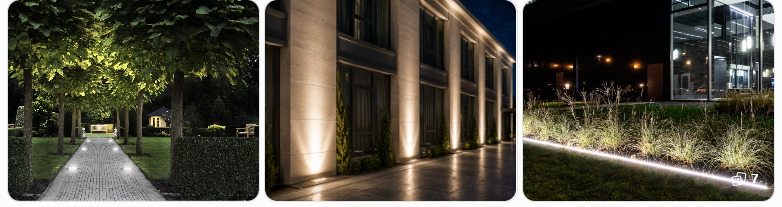
Hotels and resorts: Recessed uplights can emphasize entrances, palm trees, façades, pathways, and water features while keeping the daytime landscape visually clean.
Commercial buildings: Narrow-beam fixtures can highlight columns, textured façades, signs, and architectural geometry.
Residential landscapes: Smaller low-voltage systems can provide pathway guidance and subtle tree or planting-bed illumination.
Public plazas and parks: Durable recessed fixtures can define pedestrian circulation and architectural landmarks.
Driveways and parking areas: Heavy-duty, walk-over or drive-over luminaires can integrate lighting directly into paved surfaces when the product's mechanical rating and foundation design are appropriate.
Bridges and urban infrastructure: Linear in-ground systems can create continuous guidance lines and architectural accents. Some commercial systems are specifically designed for parks, squares, roads, pedestrian areas, bridges, airports, and other infrastructure environments.
Trends Shaping the Next Generation of In-Ground Lighting
The market is moving toward greater control, better optical precision, and more application-specific construction.
One important development is smart lighting control. DALI, DMX, wireless control, tunable white, and other systems allow lighting levels and color characteristics to be adjusted according to time, events, or operating requirements. Current commercial products already offer combinations of DALI 2, DMX, NFC, and wireless control options.
Another trend is more precise light distribution. Instead of simply increasing lumen output, designers are using asymmetric optics, wall-washing distributions, narrow beams, and glare-control structures to place light where it is actually needed.
Improved material durability is also becoming increasingly important. Stainless-steel construction, advanced coatings, improved sealing systems, and chemically resistant encapsulation can extend reliability in demanding environments.
Finally, energy performance and controllability are likely to become increasingly connected. Efficient LEDs combined with dimming and scheduled operation can reduce unnecessary nighttime energy consumption. DOE guidance likewise identifies advanced controls as a means of achieving additional energy and operating-cost savings.
FAQ
Are LED in-ground lights suitable for heavy rain?
They can be, provided the fixture has an appropriate ingress-protection rating and the installation provides effective drainage. IP protection should always be evaluated together with installation conditions.
Is IP67 enough for a driveway?
Not necessarily. IP67 addresses ingress protection, not vehicle loading. Drive-over applications require a suitable mechanical/load rating and properly engineered foundation.
Which material is best for outdoor in-ground lighting?
There is no universal answer. Die-cast aluminum offers good thermal performance and cost efficiency, while stainless steel can provide greater mechanical and corrosion resistance in demanding environments. The correct choice depends on the installation environment.
What beam angle should be used?
The answer depends on the target surface and mounting distance. Narrow beams work well for architectural accents and wall grazing, while wider distributions are generally better for broad surfaces and pathway illumination.
What should buyers request from a supplier?
At minimum, request a complete datasheet, photometric files, installation instructions, certification information, material specifications, electrical data, warranty terms, and project references where appropriate.
Conclusion
The performance of LED in-ground lights is determined by far more than LED chip efficiency. Optical distribution, thermal design, housing materials, impact resistance, waterproof construction, drainage, installation quality, and electrical controls all influence the final result.
For B2B projects, the most reliable approach is to specify the fixture according to its actual environment: pedestrian, landscape, architectural, coastal, or drive-over. Suppliers should be assessed through measurable technical documentation, testing evidence, manufacturing consistency, and application support rather than headline specifications alone.
When these factors are considered together, LED in-ground lights can provide a discreet and durable lighting layer that enhances landscape structure, architectural form, nighttime wayfinding, and outdoor user experience while maintaining the clean visual character demanded by modern projects.

 Español
 Portugues
 Pусский
 Français
 Deutsch
 日本語
 한국어
 العربية
 Italiano
 Nederlands
 Ελληνικά
 Svenska
 Polski
 ไทย
 Türk dili
 हिन्दी
 Indonesia
 Melayu
 Tiếng Việt
 中文
 dansk
 Magyar
 қазақ
 বাংলা
 עִברִית
 čeština
 Soomaali
 မြန်မာ
 فارسی
 українська
 norsk
 Gaeilge
 беларускі
 Română
 ພາສາລາວ
 Filipino
 lietuvių
 Cymraeg
 македонски
 Suomalainen
 slovenský
 o'zbek
 اردو
 հայերեն
 Igbo
 български
 سنڌي
 Shona
 සිංහල
 Hrvatski
 íslenskur
 galego
 català
 Zulu South Africa
 Afrikaans isiXhosa
 ಕನ್ನಡ
 lëtzebuergesch
 Indonésia Sunda
 Кыргызча
 тоҷикӣ
 Србија
 Twi
 Hawaii
 Cebu
 नेपाल
 euskara
 frissi
 יידיש
 latvija
 slovenija
 kiswahili
 ਪੰਜਾਬ
 پښتو
 საქართველოს
 hua moni
 bosna
 Kreyòl ayisyen
 Eesti
 Gàidhlig na h-Alba
 Samoa
 Монгол
 Azərbaycan
 አማራ
 Shqipëria
 Malagasy
 Malta
 ខ្មែរ
 Chicheva
 中文(繁体)
 ଓଡିଆ
 Setswana
 Afrikaans
 Aymara
 Башҡорт
 Türkmenler
 ትግሪኛ
 Afaan Oromoo
 অসমীয়া
 Kinyarwanda
 Ilocano
 Wolof
 अवधी
 Oluganda
 Bikol
 Fulɓe
 Kikongo
 Sango
 ދިވެހި
 Lingala
 मैथिली
 Tsonga
 ꯃꯦꯏ ꯊꯥꯏ꯫
 brezhoneg
 Furlan
 नेवा
 རྫོང་ཁ
 Santali
 Аҧсуа
 Нохчийн
 Чӑваш
 Татар
 Batak Karo
 دری
 Diura
 Fengyu
 Eʋegbe
 Iban
 Fiji
 Tonga
 Inuktitut
 Nahuatl
 maaya yucatec
 Runasimi
 guarani
 Qafar
 Acholi
 Dinka
 Luo
 Lundi
 isiNdebele
 Tshivenḓa
 Sesotho sa Leboa
 Sesotho sa Borwa
 Ndumbe
 Papuan Pidgin
 Rromani ćhib
 Thok Nath



 Phone
Comment
(0)